Alfalfa leaves the field as one of the best forages a farmer can produce. It is high in protein, rich in calcium, and highly digestible. Dairy cows produce more milk on it. Horses hold condition on it. Rabbits, goats, and sheep all benefit from it. Yet by the time that same alfalfa reaches the feed trough, its value may have quietly slipped away. Leaves have shattered. Fines have blown off. Nutrients have oxidized. What was premium forage in the field has become something far less consistent in the bunk.
That gap between field and feed trough is where money is lost. It is also where processing decisions matter most. Baling, storing, and feeding hay all cause losses. Some are visible—dust, leaf litter, rejected stems. Others are invisible—reduced digestibility, variable nutrient content, and lower intake. The cumulative effect is a crop that never delivers the full value it promised when it was growing.
For feed producers and livestock operations that depend on alfalfa, closing that gap is not a matter of working harder. It is a matter of processing smarter. And that is where a complete alfalfa pellet production line changes the economics of the entire crop.
The Losses That Happen After Harvest
Alfalfa is fragile. The leaves are where most of the protein, vitamins, and minerals are stored. They are also the part most easily lost. Raking, baling, loading, transporting, and feeding all cause leaf shatter. Research has shown that leaf loss can reach 15% to 30% or more between cutting and consumption. That is not just a cosmetic issue. It is a direct reduction in feed value.
The stems that remain are higher in fiber and lower in energy. They are also less palatable. Animals often sort through hay, eating the leaves and leaving the stems behind. The feed that was formulated to meet nutritional requirements becomes something else entirely by the time it is actually eaten.
Storage adds another layer of loss. Hay that is baled at the wrong moisture level can heat, mold, or spoil. Vitamins degrade over time. Even under good storage conditions, hay quality declines slowly. The crop that was harvested in June may be significantly less nutritious by December.
Weather makes everything worse. Rain during curing leaches soluble nutrients. High humidity encourages mold. Delayed baling reduces quality. Every delay and every weather event takes a toll.
Why Pellets Change the Equation
Pelleting addresses the loss problem at its source. Instead of trying to preserve the leaf and stem separately, the entire plant is ground and mixed together. The leaves cannot shatter and blow away because they are no longer whole leaves. They become part of a uniform meal that is compressed into dense, stable pellets.
The pelleting process also improves digestibility. Heat and pressure gelatinize starches and break down some of the fibrous structures. The result is a feed that animals can use more efficiently. More of what they eat is converted into milk, meat, or fiber.
Consistency is another advantage. Hay varies from field to field, cutting to cutting, and bale to bale. Pellets are uniform. Every pellet contains the same balance of nutrients. Feeders can formulate rations with confidence, knowing that the alfalfa pellets they use will perform the same way every time.
There is also the matter of storage and transport. Pellets are dense. They take up far less space than baled hay. They can be stored in bins or silos and moved with standard conveying equipment. They ship economically, which opens markets that were never available to hay producers.
What a Complete Line Actually Includes
A pellet is not made by a single machine. It is the result of a sequence of steps that must work together. A complete line typically includes grinding, mixing, conditioning, pelleting, cooling, screening, and packaging. Each stage affects the quality of the final product.
Grinding is the first step. A hammer mill reduces the alfalfa to a consistent particle size, usually 2 to 4 millimeters. If the grind is too coarse, the pellets will be weak. If it is too fine, the pellets may be too dense and less palatable. Consistent grinding is essential for consistent pellets.
Mixing follows. Alfalfa may be blended with other ingredients—grains, protein meals, minerals, or binders—depending on the target market. The mixer must blend everything thoroughly so that every pellet carries the same nutritional profile.
Conditioning is where steam is added. The heat and moisture soften the fibers and activate the natural binders in the plant. Conditioning temperature and retention time must be controlled carefully. Too little conditioning produces crumbly pellets. Too much makes the material sticky and difficult to press.
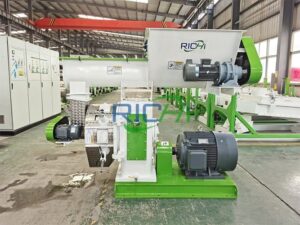
The pellet mill is the heart of the line. It forces the conditioned material through a die under high pressure. The friction generates additional heat, which melts the natural lignin and binds the particles together. The die hole diameter determines the pellet size. For alfalfa, pellets are typically 4 to 8 millimeters, depending on the animals being fed.
Cooling follows pelleting. Fresh pellets are hot and soft. They must be cooled to harden and to reduce moisture to a stable level. A cooler uses air to remove heat and moisture. Proper cooling prevents spoilage and improves durability.
Screening removes fines and broken pellets. The fines are recycled back into the process. Screening ensures that the finished product meets the size and quality specifications expected by the market.
Packaging or bulk loading is the final step. Pellets can be bagged for retail sale or loaded into bulk trucks for delivery to feed mills, farms, or export terminals.
The Importance of Line Integration
A complete line is more than a collection of machines. The equipment must be sized and configured to work together. If the grinder produces more material than the pellet mill can handle, the line will bottleneck. If the cooler is too small, the pellets will not harden properly. If the screener is inefficient, the final product will contain too many fines.
Integration also affects labor and energy use. A well-designed line moves material smoothly from one stage to the next with minimal handling. It uses energy efficiently. It requires less operator intervention. The result is lower production costs and more consistent quality.
For producers who are new to pelleting, the learning curve can be steep. That is why the manufacturer’s experience matters. A supplier who understands alfalfa—its fiber, its abrasiveness, its conditioning requirements—can recommend the right die, the right conditioning parameters, and the right line configuration. That knowledge shortens the path to consistent production.
What to Look For in Equipment
Not all pellet mills are suited to alfalfa. Alfalfa is fibrous and abrasive. The die must be made from wear-resistant alloy. The rollers must be precisely machined. The bearings must be sealed against dust and moisture. The conditioner must be capable of delivering steam consistently. The cooler must be sized for the throughput.
The die configuration is especially important. The compression ratio affects pellet density and durability. A die that is too tight produces hard pellets that animals may reject. A die that is too loose produces soft pellets that crumble during handling. The right die balances durability with palatability.
The pellet mill motor must be sized for the load. Alfalfa requires more power to compress than many other materials. An undersized motor will struggle, overheat, and wear out prematurely. An oversized motor wastes energy. The correct motor size depends on the capacity and the die configuration.
The Manufacturer Behind the Line
Equipment is only part of the equation. The support behind the equipment determines how well the line performs over time. Richi Manufacture has worked with feed producers and farmers in many countries, designing lines for different materials and different markets. Their experience with fibrous forages helps them match equipment to the specific demands of alfalfa.
The support includes system design, equipment selection, installation guidance, operator training, and after-sales service. Spare parts availability is also critical. Dies and rollers are wear items. They will need replacement. A supplier who can provide genuine parts quickly keeps the line running. A supplier who cannot leaves the producer waiting and losing money.
The Market for Alfalfa Pellets
Alfalfa pellets serve several markets. Dairy farms use them as a protein supplement in total mixed rations. Horse owners value them for their high nutritional content and low dust. Rabbit and small animal producers use them as a primary feed. Export markets buy them for regions where alfalfa cannot be grown or where hay is scarce.
The fuel market is smaller for alfalfa than for wood or straw, but it exists. In some regions, low-grade alfalfa pellets are used in biomass boilers. The ash content and slagging behavior must be considered, but for certain applications, alfalfa pellets are a viable renewable fuel.
The premium markets—dairy, horses, and small animals—pay for consistency, cleanliness, and nutritional quality. That is where a well-run production line can differentiate itself. Consistent pellets command better prices. Inconsistent pellets are discounted or rejected.
The Economics of Pelleting Alfalfa
The decision to invest in a pelleting line is economic. The costs include equipment, installation, energy, labor, maintenance, and financing. The benefits include reduced leaf loss, improved feed efficiency, access to new markets, and better storage and transport economics.
The reduction in leaf loss alone can be significant. If 20% of the crop is currently lost between field and feeder, pelleting can recover most of that value. On a large alfalfa operation, that recovered value can cover a substantial portion of the equipment cost.
The revenue from pellet sales adds to the return. Alfalfa pellets typically sell at a premium to baled hay because of their consistency and convenience. Export markets often pay especially well for high-quality pellets that meet protein and durability specifications.
The operating costs are predictable. Electricity is the largest variable cost. Labor depends on automation. Maintenance depends on wear parts and operating hours. A well-designed line with good support will have lower long-run costs than a poorly designed one.
Making the Decision
Producing alfalfa pellets is not for every operation. It requires a reliable supply of alfalfa, a market for the pellets, and the capital to invest in equipment. It also requires a willingness to learn the process and to maintain quality consistently.
For operations that have the supply and the market, pelleting can transform alfalfa from a commodity into a branded, value-added product. It can reduce waste, improve animal performance, and open new revenue streams. The technology is proven. The equipment is available. The question is whether the economics work for your specific situation.
If you want to compare line configurations, capacity options, and real-world performance data, click here for more info to explore the details that matter before you invest. The right line, properly integrated and supported, can turn a fragile forage into a stable, marketable product that delivers value from the field all the way to the feed trough.