Modern agriculture produces food, animal feed, livestock waste, and crop residues as interconnected parts of one system.
The challenge is that these materials are often managed separately.
A poultry farm produces manure.
A fertilizer producer purchases organic materials.
A crop farm purchases fertilizer.
Transport connects all three, but the material flow is not always efficient.
Chicken manure pellet production creates an opportunity to connect these activities more closely by transforming agricultural residue into a standardized fertilizer product.
From Waste Stream to Input Stream
The most useful way to think about manure pelletizing is not simply as waste treatment.
It is a conversion process.
The original material has limited convenience because it is loose, variable, and difficult to transport.
After appropriate treatment, the material becomes a more compact and manageable fertilizer granule.
That physical transformation can make storage and distribution easier.
In a circular farming model, this means an agricultural by-product can re-enter the agricultural economy as an input.
The value lies in the system rather than in the manure alone.
Why Granules Are Convenient for Distribution
Loose organic material can create logistical challenges.
It may require more handling space, and moisture can increase transport weight.
Granulation produces a denser and more standardized form.
The resulting fertilizer can be packed in bags or transported in bulk depending on the market.
The form of the product also makes mechanical application more practical for many agricultural operations.
This does not mean every manure project should become a pellet plant. The economics depend on local conditions.
However, where manure supply and fertilizer demand are closely connected, pelletizing can become an attractive processing strategy.
The Production Chain
A typical chicken manure fertilizer process may look like this:
Collection → stabilization → drying → crushing → mixing → granulation → cooling → screening → packaging.
Each stage solves a different production problem.
Stabilization prepares the organic material.
Drying manages moisture.
Crushing improves particle condition.
Mixing creates a uniform formulation.
Granulation shapes the product.
Cooling prepares it for downstream handling.
Screening controls particle size.
Packaging completes the commercial process.
This chain creates a bridge between agricultural residue and a market-ready fertilizer.
What Role Does the Pelletizing Machine Play?
At the center of this conversion is the forming stage.
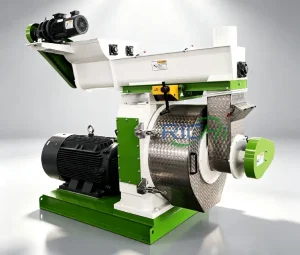
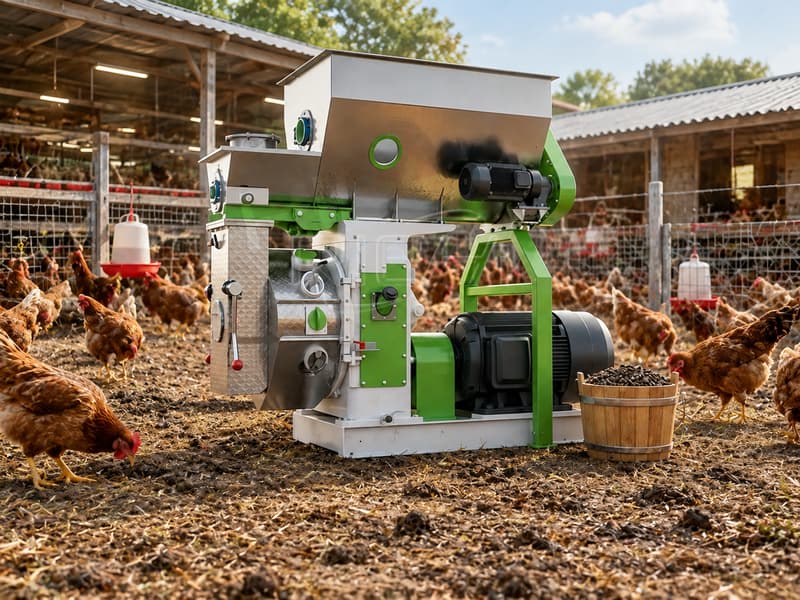
The chicken manure pelleting equipment must receive material that has already been prepared appropriately.
The equipment compresses and forms the material into granules according to the process design.
The machine is important, but it cannot compensate for severely inconsistent raw material.
This is why circular agriculture still requires industrial process thinking.
Using waste materials does not mean production standards can be ignored.
Regional Supply Can Change the Economics
A circular model becomes more practical when agricultural material does not have to travel excessive distances.
Consider a region with many poultry farms and a strong agricultural customer base.
Manure can be collected from nearby farms, processed at a centralized facility, and transported as finished fertilizer to surrounding agricultural areas.
This arrangement can create a more organized local material loop.
By contrast, transporting wet manure across very long distances may increase the cost before processing even begins.
Location planning is therefore a major component of the business model.
What Can Farmers Gain from Local Processing?
For farms, the main benefit may be improved manure management.
Instead of storing large amounts of loose manure or paying for external disposal, producers may have access to a local processing channel.
The resulting fertilizer can then be sold, distributed, or potentially used within an appropriate agricultural system subject to local requirements.
This can create a new relationship between livestock production and crop production.
The farm is no longer viewed only as the source of agricultural waste.
It becomes part of a wider resource cycle.
Why Product Standardization Matters
Circular agriculture still depends on product quality.
Agricultural customers need predictable products.
A fertilizer producer therefore needs to manage raw-material variation and maintain consistent production conditions.
This is one reason process equipment matters.
For example, the mixer helps distribute multiple raw materials.
The dryer helps maintain the required moisture range.
The granulator produces a regular physical form.
The cooler supports product handling.
The screen controls final particle size.
When these machines work together, the fertilizer becomes easier to standardize.
The Importance of Flexible Formulation
A fertilizer producer may not want to depend on poultry manure alone.
Different seasons may change the quantity of manure available.
Market demand may also change.
A flexible system can allow the producer to formulate products using more than one organic ingredient, provided the recipe meets the relevant product requirements.
This flexibility can make the plant more adaptable to regional supply.
It also gives the business more opportunities to create differentiated fertilizer products.
What Size of Plant Makes Sense?
There is no universal answer.
The correct scale depends on the quantity of manure available, the distance to suppliers, the expected fertilizer demand, and the intended operating schedule.
A project based on one large poultry farm may require a different configuration from a regional manure collection business.
When reviewing equipment options such as a 2-3T/H Cow Manure Fertilizer Pellet Machine, operators can use the nominal capacity as a reference point, but they should also consider how many hours the line can realistically operate and what actual feedstock will be available.
The annual raw-material supply is often more meaningful than a machine’s advertised maximum capacity.
What About Packaging?
Packaging is sometimes treated as the final detail.
For a circular agricultural business, it can actually influence the sales strategy.
Large farms may prefer bulk deliveries.
Retail distributors may prefer smaller bags.
Some fertilizer wholesalers may have their own packaging systems.
The plant should therefore have enough flexibility to accommodate the intended sales channel.
Packaging also protects the final product during transportation and storage.
Automation and Resource Efficiency
A circular production system is not automatically resource-efficient.
The plant still consumes electricity, fuel, labor, and maintenance resources.
Efficiency comes from optimizing the entire process.
Drying should remove the required amount of moisture without excessive energy use.
Conveying systems should move material efficiently.
Granulation should operate within an appropriate range.
Cooling should match actual production output.
Screening should minimize unnecessary material recycling.
Automation can help coordinate these stages in larger plants.
The objective is not maximum automation for its own sake, but better control over the material flow.
(Related Post:https://www.richipelletmill.com/organic-fertilizer-production-line/)
Can Poultry Farms Become Part of the Fertilizer Business?
In some regions, integrated agricultural businesses may choose to process manure themselves.
A large poultry producer may install a dedicated fertilizer pellet production line and manage both manure handling and product manufacturing.
Another model is cooperation with an independent fertilizer company.
The poultry farm supplies manure.
The fertilizer company handles treatment and pellet production.
The finished fertilizer then returns to the agricultural market.
The best structure depends on land ownership, fertilizer demand, capital availability, local regulations, and logistics.
What Should a Circular Fertilizer Project Measure?
A mature project should track more than tons per hour.
Useful operating indicators include:
Raw-manure moisture
Dryer performance
Granule size distribution
Fines generation
Reprocessing percentage
Energy consumption
Packaging output
Raw-material transport distance
Finished-product transport distance
These indicators can show whether the project is creating value beyond simple production volume.
For example, reducing unnecessary transport can be just as important as increasing machine throughput.
The Broader Agricultural Opportunity
The future of manure processing is closely connected to resource efficiency.
As agricultural producers look for ways to use materials more effectively, organic fertilizer processing can become part of a broader resource-management strategy.
Poultry manure is not the only material suitable for this approach.
Other agricultural residues may be incorporated into different production systems depending on local requirements and equipment configuration.
The central concept remains the same: create a useful product from a material that previously had limited commercial convenience.
When Should a Producer Consider Professional Engineering Support?
Professional engineering support becomes increasingly valuable when the project includes multiple raw materials, automatic feeding, large drying systems, customized formulations, or high production capacity.
A machine supplier can help evaluate process flow, equipment selection, power requirements, layout, and production targets.
This is especially helpful when the business plan depends on achieving a specific output.
The right engineering approach can reduce the risk of selecting equipment that works individually but does not perform well as a complete system.
Additional technical material and project ideas are available when you can look here for more information on fertilizer processing and pellet production.
Final Thoughts
Chicken manure pelletizing fits naturally into the concept of circular agriculture because it creates a pathway for organic residue to move back into the agricultural supply chain.
The real opportunity is not simply producing granules.
It is connecting poultry production, manure management, fertilizer manufacturing, transportation, packaging, and agricultural demand into one coordinated system.
For farmers and investors, this perspective changes the way a project should be evaluated.
Instead of asking only whether chicken manure can be pelletized, a better starting point is to ask:
Where will the manure come from?
How will it be stabilized?
What moisture condition is required?
Who will purchase the finished fertilizer?
How far will the raw material and finished product travel?
What capacity can the local supply actually support?
Once those questions are answered, the machinery configuration becomes much easier to define.
A well-designed manure fertilizer plant can therefore serve as more than a processing facility. It can become a link between livestock production and crop production, helping agricultural resources move through a more organized and commercially useful cycle.