A New Product Does Not Always Require a New Business
Pet-product companies often expand by adding products that can be marketed to their existing customers.
A company already selling litter boxes, pet pads, toys or grooming supplies may already have relationships with distributors and retailers.
Adding a new type of cat litter could therefore be commercially interesting.
Wood-based litter is one possible direction, particularly for manufacturers looking to build a plant-based product line.
The challenge is deciding how to integrate production into an existing factory without creating an overly complicated operation.
This requires a different way of thinking about equipment.
Instead of asking, “Which machine makes cat litter?” manufacturers should ask, “What production structure fits our existing business?”
The Existing Factory May Already Have Valuable Resources
A pet-product manufacturer may already have:
- Warehouse space
- Packaging equipment
- Finished-product storage
- Electrical infrastructure
- Forklifts
- Quality-control staff
- Product-development teams
- Distribution channels
That means some parts of a new project may already exist.
The real challenge is often the material-processing side.
Sawdust and wood residues need to be received, stored and processed under appropriate conditions before they can become a consistent litter product.
The production area should therefore be designed as an extension of the existing factory rather than automatically treated as a completely separate operation.
A Different Customer Means a Different Product
One reason the transition from one product category to another can be difficult is that manufacturing requirements may change with the customer.
Industrial biomass products are often evaluated by throughput, density and fuel performance.
Pet products involve more user-facing characteristics.
Customers may care about:
- Dust
- Odor
- Particle shape
- Absorption
- Handling
- Bag cleanliness
- Storage convenience
- Product consistency
This changes the quality-control philosophy.
The factory must think about the consumer experience, not just production output.
Start With a Product Brief
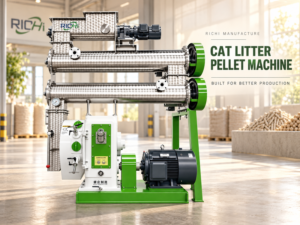
Before purchasing Sawdust Cat Litter Making Machine, create a simple product brief.
For example:
Target product: Wood-based cat litter
Material: Clean sawdust
Particle size: Defined according to market research
Moisture: Controlled for storage stability
Packaging: Retail bags
Primary selling points: Low dust, natural material, consistent particle size
The brief gives engineers something concrete to design around.
It also prevents equipment discussions from becoming too vague.
What Kind of Raw-Material Preparation Might Be Required?
The amount of preprocessing depends heavily on where the material comes from.
A company buying clean sawdust from woodworking factories may receive a relatively uniform feedstock.
Another company may collect mixed material from multiple suppliers.
The second situation normally creates greater preparation requirements.
Large particles may need size reduction.
Moisture may need adjustment.
Foreign material should be removed.
Different material batches may need blending before production.
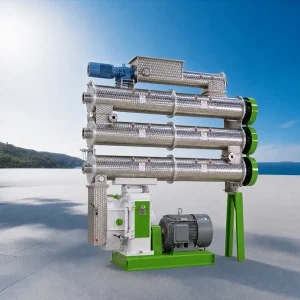
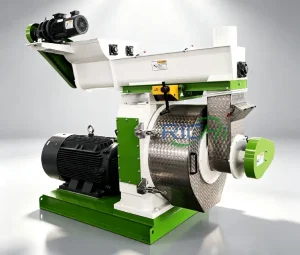
For a smaller project, a 2-3 T/H animal bedding pellet making machine for sale can be a useful benchmark when investigating equipment configurations for wood-based bedding products.
The final selection, however, should still be based on actual raw-material testing.
Why Material Blending Can Be Useful
A factory depending on several sawdust suppliers may face daily variation.
One supplier may provide softer wood.
Another may provide denser material.
One load may be relatively dry.
Another may contain significantly more moisture.
Instead of allowing these differences to reach the forming section directly, the factory can use controlled blending.
Blending can help create a more uniform feed mixture.
This does not eliminate raw-material variation, but it can make the production process more predictable.
For larger operations, consistent blending can become a major part of quality management.
The Product Should Not Be Over-Processed
There is a tendency to assume that finer material automatically creates better cat litter.
That is not necessarily true.
Excessive milling can increase energy demand and generate more fines.
The most useful particle structure is the one that supports the intended forming behavior and final product performance.
The manufacturer should therefore determine the appropriate size range through testing rather than pursuing the smallest possible particles.
This is particularly important for factories that already have milling equipment for other products.
Existing machinery may be reusable, but its settings and screen configuration may need adjustment.
Conditioning and Forming Need to Match the Material
Wood particles contain natural fibers, and those fibers influence compression and binding behavior.
The material condition entering the forming section therefore matters.
Feed rate, moisture and particle distribution all contribute to production stability.
A pellet maker may provide the mechanical forming function, but the finished result is influenced by the conditions around it.
This is why experienced process engineers look at upstream and downstream systems as well.
If the feed is inconsistent, the forming section cannot fully compensate for the problem.
What About Product Odor?
Wood has a natural smell, which can be either a positive feature or something that manufacturers want to modify.
Some brands may prefer to market the natural wood character.
Others may add fragrance or odor-control components.
The product-development strategy should determine whether additional liquid or powder additives are needed.
When additives are introduced, the factory needs to consider:
- Uniform distribution
- Safe dosing
- Mixing
- Storage
- Product labeling
- Compatibility with the raw material
The production line should be designed around the actual formulation.
Retail Packaging Requires More Attention Than Industrial Bulk Handling
A pet-product company may already have packaging equipment, but the bagging requirements for litter can still differ from other products.
Litter is relatively dense, dusty and sometimes abrasive.
The packaging system should provide:
- Stable filling
- Accurate weighing
- Effective sealing
- Clean bag handling
- Reliable dust management
Packaging line speed should also match the actual production capacity.
There is little benefit in producing material faster than it can be packed.
One Factory Can Serve Multiple Product Segments
One potential benefit of biomass-based litter production is the ability to use a similar raw-material base for multiple markets.
A factory could potentially create separate product lines such as:
Cat litter
Designed around pet-owner requirements.
Small-animal bedding
Suitable for rabbits, guinea pigs or similar applications, subject to product requirements.
Large-animal bedding
Focused on larger animals and different handling conditions.
Biomass fuel products
Used in energy applications rather than pet products.
These products are not identical, but the underlying raw-material processing knowledge can overlap.
That creates opportunities for strategic diversification.
Cleaning and Product Changeover Matter
A multi-product factory must think carefully about changeover.
Wood-based pet products can differ in:
- Additives
- Particle specifications
- Packaging
- Target markets
The production system should therefore allow practical cleaning and inspection between products.
Material remaining in conveyors or hoppers can affect the next batch.
Even when the products use similar raw materials, changeover procedures should be clearly documented.
Quality Control Should Follow the Product
A factory may already have an industrial quality-control system, but pet litter requires product-specific checks.
Useful measurements may include:
- Particle size distribution
- Moisture
- Bulk density
- Dust generation
- Packaging weight
- Product appearance
- Storage stability
Customer complaints should also feed back into the production process.
For example, repeated complaints about excessive powder could indicate that the issue is happening during screening, conveying or packaging rather than during forming.
Supplier Selection Should Include Engineering Support
An equipment company should not be evaluated solely on the price of individual machines.
Manufacturers should also examine whether the supplier can:
- Analyze raw material
- Recommend a process route
- Match equipment capacities
- Design material handling
- Assist with electrical integration
- Provide installation guidance
- Support commissioning
For a company expanding into a new product category, technical coordination may be just as important as the machine itself.
Richi manufacture can be one point of comparison when researching suppliers for complete biomass and feed-related equipment solutions.
The project should still be evaluated according to the specific technical requirements rather than brand name alone.
Is It Better to Start Small?
For companies entering the category for the first time, a smaller commercial line can provide useful market feedback.
The factory can observe:
- Which particle size customers prefer
- Which packaging format sells
- How often customers reorder
- What quality complaints occur
- Which raw materials are easiest to manage
- What distribution channels work
This information can guide future expansion.
A production line should be scalable where practical, but investment decisions should be based on actual business demand rather than assumptions.
A Business Model Built Around Existing Strengths
The strongest argument for adding wood-based litter may not be the equipment itself.
It may be the ability to use an existing customer network.
A pet-product company that already reaches retailers can introduce a new litter product without starting completely from zero.
A woodworking company has a similar advantage on the raw-material side.
The most successful projects often connect an existing strength with a new market opportunity.
For additional background reading on equipment integration and biomass product development, see these helpful resources.
Conclusion
Adding wood-based cat litter to an existing pet-product business requires more than installing a forming machine.
The factory must consider raw-material consistency, product requirements, packaging, quality control, cleaning, storage and market positioning.
The opportunity becomes more practical when the new production system is designed around assets the company already has.
That might include a warehouse, packaging system, distribution network or steady access to clean sawdust.
The result is not simply another machine in the factory. It is a new product category supported by an existing business structure.